Hedging: yes or no?
Written by editor on July 29, 2026
TL;DR
Hedging against USD swings isn't free: the real cost is the interest rate differential between the US and the Eurozone - currently ~1.32% a year. These cost are not visible in the fund's TER. On a 4% USD yield, hedging eats a third of it. My rule: EUR exposure for most bonds, part of equities, rest unhedged.
Why currency hedging?
For European investors, building an income portfolio means looking beyond the Eurozone. We are just such a small part of the financial markets.
So you look at ETFs that hold US securities, global corporate bonds, or emerging market debt. Attractive yields, useful diversification. But investing abroad introduces an unseen factor in your returns: currency risk.
When you buy an unhedged ETF holding foreign assets, your return in Euros depends on both the asset’s local performance and the exchange rate. Because of the size of the US financial markets, the EUR/USD currency pair has the most impact.
An example: if the US stock market stays perfectly flat, but the dollar weakens 10% against the Euro, your investment loses 10% in value. You think a 10% swing is unlikely? Look at the chart below, based on ECB reference rates:
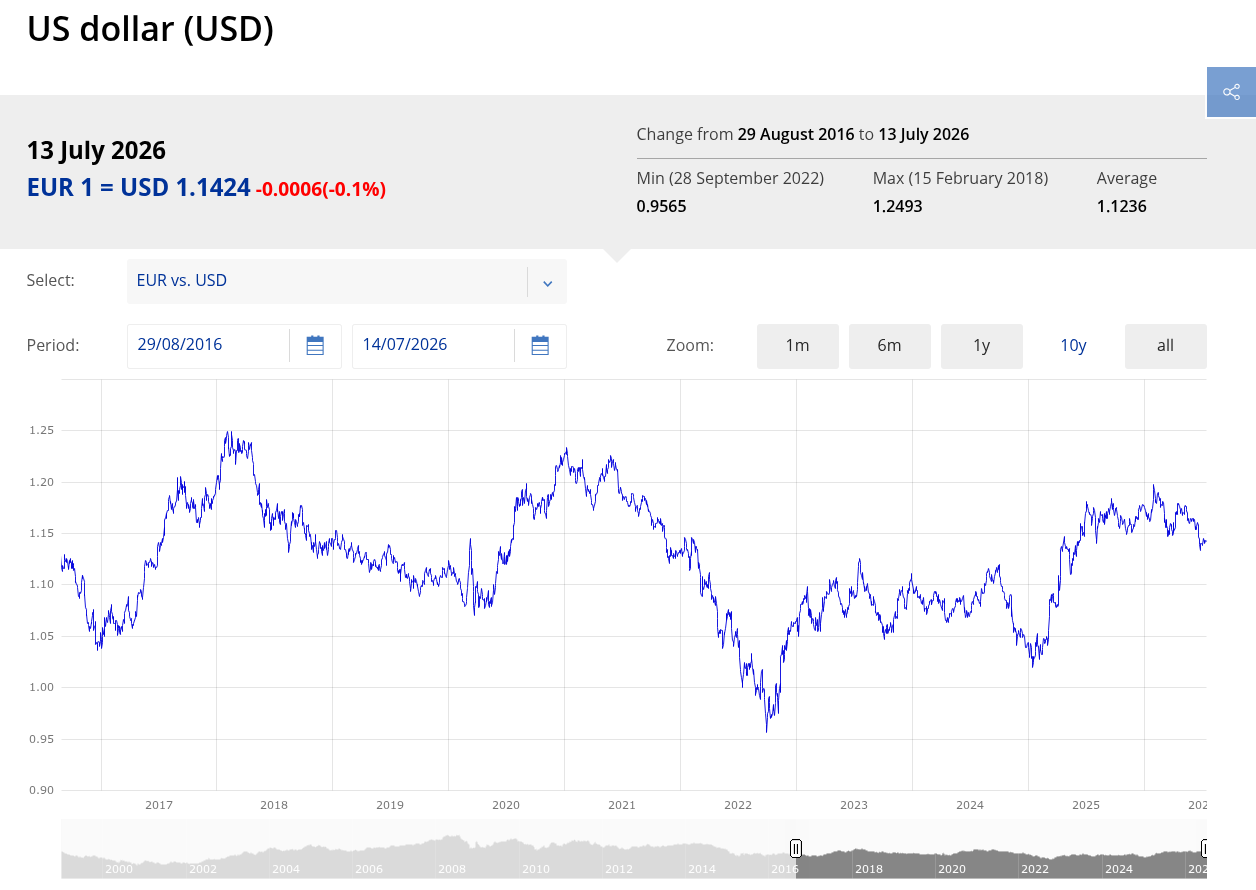
In 2020 the dollar weakened from 1.08 to 1.23 - roughly +14% for EUR/USD. Then the reversal: to 0.96 by late 2022, about -22%. And in 2025, the USD weakens again, from 1.04 to 1.18, another +14% for the EUR. Three double-digit swings in five years. Zoom out to the full ten years, though, and the pair is close to where it started.
That last point matters: over a long enough horizon, it evens out.
Foreign dividends and coupons carry the same risk. A lucrative 4-5% yield can shrink fast once converted back to Euros. A bad currency move can wipe out the reason you held the asset in the first place. Of course, the move can go the other way too. Like all types of risk, currency risk can benefit you or hurt you.
If you want to remove volatility and protect the value of your investments in Euro, currency hedging is an option.
What hedging actually costs
Currency-hedged ETFs mostly use one-month forward contracts, rolled over automatically, to lock in the EUR/USD rate on your US holdings. In principle this neutralises the currency swings above, leaving you with something close to the pure USD-asset return.
That protection isn’t free, and the price tag is bigger than the fund’s TER suggests. The SPDR S&P 500 EUR Hedged UCITS ETF I looked at in part 3 carries a TER of just 0.05%. Cheaper than plenty of unhedged funds. Barely a rounding error. But the TER only covers fund administration. It says nothing about the actual cost of the hedge itself.
That cost is driven almost entirely by the interest rate differential between the US and the Eurozone. As a rule: hedging a currency with a higher reference rate than the Euro costs you money; hedging one with a lower rate pays you. This is basic interest rate parity at work - forward rates adjust, so nobody earns a free lunch by borrowing cheap and hedging into a higher-yielding currency.
If this is all a bit technical, think of it this way. If I have USD, I get a higher interest rate than when I have EUR. So when I convert money from USD to EUR, I give up that higher interest rate for a lower one. Exactly that is the interest rate differential. And a currency hedge is much like a currency conversion.
Right now, the benchmark US rates are high. As of July 2026:
| Rate | Value |
|---|---|
| US Fed Funds (upper bound) | 3.75% |
| ECB main refinancing rate | 2.40% |
| Differential | 1.35% |
| Annualised EUR/USD hedging cost* | 1.32% |
Table: US/Eurozone rate differential and the resulting EUR/USD hedging cost. *Source: LazyPortfolioETF, based on ECB and Fed reference rates, data as of 25 July 2026.
So, 1.32% a year! That’s the invisible extra cost sitting on top of the 0.05% TER - roughly 25 times the size of the visible fee. And unlike the TER, it moves with every ECB and Fed decision. A year ago it was closer to 2.4%, when the gap between the two central banks was wider.
For an income investor this has enormous impact.
Say you hold a US dividend ETF yielding 4.00%. Hedge it back to EUR, and roughly 1.3 percentage points of that yield disappears into the interest rate differential - your effective net yield drops to about 2.7%. In other words, you’ve spent a third of your returns to remove volatility.
If you want another view, Morningstar asked whether currency-hedged ETFs have merit for the long term and concludes: the TER is only part of the story, and the hedge is worth paying for mainly when volatility itself is the enemy, not as a default. justETF’s explainer on ETF currency risk is useful too. It untangles underlying currency, fund currency and trading currency. A distinction that confuses a lot of people comparing the same ETF listed on different exchanges.
My takeaways
Given a cost like the 132bps above, hedging should be approached with caution:
- Bonds: I still lean towards pure EUR or hedging here. Bond volatility is already low, so an unhedged FX swing can dwarf the underlying return and defeat the point of holding fixed income at all.
- Stocks: Here the math bites harder. On the SPDR S&P 500 comparison in part 3, the hedged version protected returns in years the dollar rallied, like 2025. However, over time my returns are much, much worse. That’s why I ended up choosing the unhedged version, despite my 40% target EUR allocation.
My practical rule is to get EUR exposure for most of the bonds, get part of the equities in EUR, and let the rest ride unhedged. It’s not the TER I worry about. It’s the interest differential eating into returns every single year, currency swing or not.