Why I underweight the US
Written by Editor on July 6, 2026

TL;DR
My target regional allocation is 45% US, 30% Europe, 25% Other. The 45% US is a big and deliberate cut versus the ~71% US weight in MSCI World and ~63% in MSCI ACWI. My reasons: concentration risk, a currency problem, and a shifting geopolitical landscape - the hardest of the three to quantify, but maybe the most important.
Why this deserves its own post
Part 1 raised the US underweight almost in passing, as item 2 of “three extra conditions” sandwiched between the 40% EUR currency target (item 1) and the Asia/EM overweight (item 3). Lets briefly look at these two first.
I need EUR because I live in the Eurozone and have bills to pay. So I have to make sure that a substantial part of my investments are in EUR or tied to the EUR because of currency risk. As for Asia and Emerging markets, I believe this is the area that will show the most economic growth in the next decade. This means I will allocate a bit more to these regions.
Now, for the US. Translating the two previous points into my asset allocation, I ended up with giving the US 50%. I felt that was too high, and I want to bring that down to 45%. Why is that? Three reasons:
- Concentration risk: too much of “global” equity indices is really only one country, one currency, and (increasingly) a handful of companies. This potentially reduces the diversification advantages that ETFs normally offer.
- Currency problem: this is a consequence of #1. Because so much equity, bonds and commodities are priced in USD, my investments are sensitive to the EUR/USD exchange rate. The currency risk is real.
- Political and institutional risk: in my opinion the US is a less predictable and reliable place to invest than it used to be.
The first two points are relatively value-free and objective because they are based on facts. You can agree or disagree with how you interpret those facts but not with the facts themselves.
The problem with the third point is that it is really more a perspective. Hard to get a good grip on. Unfortunately, this is one I worry about the most.
Reason 1: Concentration risk
Take a look at two leading world indices (July, 2026):
MSCI World: ~71% US, top 10 holdings are all US and over 25% of the index
MSCI ACWI: still ~63% US after it adds Emerging Markets to MSCI World, China only ~2.9%
Now, China’s nominal GDP is just over 60% of US GDP (2026 estimates put US GDP near USD 28.8T vs. China near USD 17.8T. So China is ≈ 62% of the US), yet gets under 3% of the index. This is not because the good people at MSCI Inc. do not like China or got the numbers wrong. They follow a strict methodology based on things like size of the various financial markets, free float and capital controls. But knowing that the Chinese equity market is about 25% the size of that of the US, the methodology somehow seems to favour the US.
Okay, so the US is dominant. Now, within the US equity markets, there is a huge concentration of capital in a small number of firms. The famous “Magnificent Seven” have gone from ~12% of the S&P 500 in 2015, to ~22% in 2022, past 30% in 2023, to roughly 32%-34% in 2026.
Then there is a third step in the concentration problem. The dominant listed large firms are all regarded as tech firms in one way or another.
What you end up with is US megacap tech representing somewhere between a quarter and a third of the entire MSCI World index. This is my main objection to simply following MSCI World.
Are there counterarguments? Absolutely. Many US companies are global multinationals, and US exchanges list plenty of non-US companies. So any major US exchange is more international than it looks. I have no problem accepting that argument.
However, it does not solve the risk of having so much capital concentrated in so few companies in the same sector.
Reason 2: Currency problem
The EUR/USD currency pair moved from about 1.04 to roughly 1.18 over 2025. The Euro gained almost 14% against the dollar, one of the sharpest annual moves in years.
Every unhedged USD position (bonds as well) lost that much in EUR terms, independent of what the underlying security did. This 14% could wipe out a couple of years of returns. A real problem if you are an investor in the Eurozone, but have securities or commodities (gold!) that are priced in USD in your portfolio.
Part 3 finds hedging expensive when comparing the hedged vs. unhedged S&P 500 UCITS, and I chose not to hedge this ETF. If hedging is off the table on cost grounds, the only remaining option to reduce USD exposure is reducing the underlying US allocation itself. So the currency risk and the regional-allocation decision aren’t two separate choices.
I feel that my third reason to underweight the US is related. A less predictable US inevitably leads to a less predictable USD. Because currency hedging is off the table as a silver bullet, the only thing I can do is diversify part of my investments away from the USD. It doesn’t necessarily need to be all in EUR - GBP or CHF work as well. As would JPY and CNY.
Reason 3: A different US
Here is an example of the modern-day US acting in the financial markets.
In summer 2026, Japan again struggled with a weak JPY. It had already sold ~$59 billion of reserves on July 30, 2026 to prop up the currency, which had hit 40-year lows. The next day, the US Treasury joined in for the first time in 28 years. However, instead of selling dollars, it sold EUR from the Exchange Stabilization Fund to buy yen, reportedly to avoid undercutting the administration’s “strong dollar” messaging. USD/JPY moved from ~164 down to ~158. Of course, EUR/JPY moved as well and in a big way. The ECB says it only found out about the EUR sale after the fact.
The fact that the ECB was not informed is regarded as an unprecedented break from decades of central-bank coordination.
More and more, the actions of the US acting on an “America First” ideology are damaging for other countries. Take the tariff wars and the constant trade tensions with China and the EU. And it doesn’t mean anything to be a loyal ally; everyone is in the line of fire. Look how the US treats Canada and Mexico. And who remembers Trump’s “revenge tax” idea in the Big Beautiful Bill? I do - it got dropped from the final bill after a G7 deal in June 2025 and never took effect, but the drive behind it tells you enough.
And, of course, it’s not just economic. Threatening with military action is par for the course these days.
You could argue that a tough and selfish US is an excellent reason to take on more US assets. You know, the 800-pound gorilla and all that. One big problem with that argument is shown in the chart below. The US total debt is over 120% of the GDP, and this number keeps rising, quickly. Debt payments are now the second-largest federal budget category, 15% of the total federal spending.
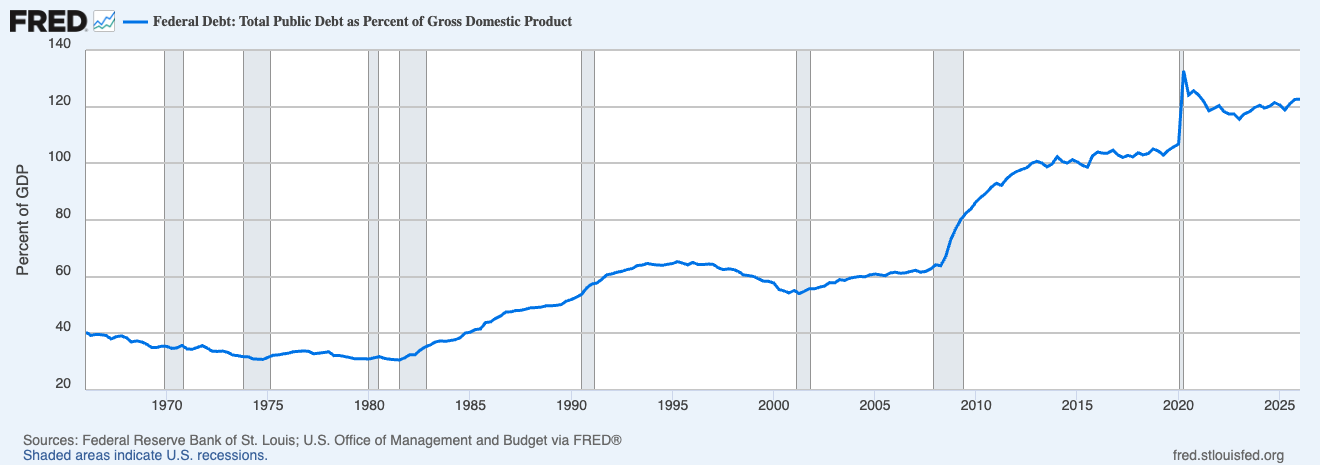
Moody’s cut the US debt from AAA to Aa1 on 19 May 2025. It was the last of the three major agencies to strip the US of a top rating (S&P did it in 2011, Fitch in 2023). All three agencies see things getting worse over the next decade. The ever-increasing debt leads to a huge supply of US Treasuries and high rates that really hurt the US.
There are many risks when debt is this high, and most are outside the scope of this blog. But if yields stay higher for longer, it will make equity less attractive. Having high yields because growth is strong is fine for stocks; high yields because investors are demanding more compensation for fiscal risk (a wider “term premium”) hurts valuations without the earnings growth to offset it. And if the rates for treasuries go up, so does the cost of capital for the economy as a whole.
The US increasingly acting alone and not caring about the effects of its actions on others is, in my opinion, one of the biggest macro risks for the coming years.
Do not think I do not see risks in other regions; I see plenty. Hard to stay above the fray.
The European Union looks a lot less stable than it did 10 years ago, and if it cracks, the EUR will go down with it. Unthinkable? Not for me. As a European, it is sickening to see how fragile European unity actually is. Then China, the leading economy in the rest of the world. China has reached the point where its economy and industrial capacity are so big that they are starting to run out of customers. In the coming decade they need to convert from a pure export-led growth model to something else. Sounds like a challenge.
However, these regions do not have the dominant role in the financial markets the US has. As an investor, I have to take this into account.
A case for not underweighting
For balance, there are good arguments on the other side, that is, to overweight the US. Here are some:
- US earnings and margins have structurally outgrown the rest of the world for over a decade. Historically, staying with winning assets has been rewarded.
- Underweighting a best-performing market because “it feels top-heavy” has a long, mixed track record. This is not a clear-cut winning strategy.
- The 2025 credit downgrade and dollar move can also be read as the market already re-pricing the risk. An indication we could have moved past the most risky point.
- The US geography is a structural advantage that outlasts any single administration. Headwinds like we see now are only a blip.
Points like these make it clear that I cannot do without the US in my portfolio. Say what you will, the US economy has proven to be highly inventive and dynamic. However, these points do not convince me that the current problems are transitory. I simply do not trust the US like I did in the past.
My takeaways
- A third of MSCI World now sits in less than 10 stocks, all riding the same megacap-tech trade. That’s not diversification; that’s a sector bet disguised as a world-index. Not using an MSCI World ETF and capping the US at 45% seems sensible.
- I did look at equal-weight ETFs for the US market, but I am not convinced. I found two videos helpful in trying to understand the pros and cons of these products: this one by Ben Felix and this one by Ramin Nakisa. Both guys are worth following.
- The 2025 EUR/USD move alone could wipe out a couple of years of expected returns, and hedging it away might well cost more than the swing itself. Cutting my US allocation is basically an affordable currency hedge.
- Tariffs on friend and foe alike, the role of the USD as reserve currency under pressure, debt over 120% of GDP with interest now the second-biggest line in the federal budget, a Fed under constant political pressure. None of these break the US on their own. But add them all together, and I feel a lot better with a reduced exposure.
Some important sources
- MSCI World Index factsheet (US weight, top constituents) - https://www.msci.com/indexes/index/990100
- MSCI ACWI factsheet (US/China weight) - https://www.msci.com/documents/10199/255599/msci-acwi-growth-target-index-usd-net.pdf
- StatisticsTimes, “Comparing United States and China by Economy” (2026 GDP figures) - https://statisticstimes.com/economy/united-states-vs-china-economy.php
- Forbes, “S&P 500’s Weight In Mag 7 Stocks Passes 30%. Is This A Diversification Risk?” (June 2026) - https://www.forbes.com/sites/investor-hub/article/sp-500-weight-mag-7-stocks-diversification-risk/
- CNBC, “Moody’s downgrades United States credit rating on increase in government debt” (May 2025) - https://www.cnbc.com/2025/05/16/moodys-downgrades-united-states-credit-rating-on-increase-in-government-debt.html
- Western Asset, “End of an Era - Moody’s Downgrades US to Aa1” - https://www.westernasset.com/us/en/research/blog/end-of-an-era-moodys-downgrades-us-to-aa1-2025-05-19.cfm
- Morgan Stanley, “Trump Fed Pressure 2025: Risks for Investors” - https://www.morganstanley.com/insights/articles/trump-fed-pressure-investing-risks-2025
- Voronoi/Visual Capitalist, “US Dollar Index Falls 10.1% in 2025, Steepest Drop in Three Decades” - https://www.voronoiapp.com/money/-US-Dollar-Index-Falls-101-in-2025-Steepest-Drop-in-Three-Decades-6776
- Currency News UK, “Euro to Dollar 2025 Review: EUR/USD Up Sharply in 2025 as US Risks Weigh” - https://www.currencynews.co.uk/forecast/20251229-44883_euro-to-dollar-2025-review-eur-usd-up-sharply-in-2025-us-risks-weigh.html
- Peter Zeihan, “The Accidental Superpower” (geography-as-structural-advantage thesis) - https://www.financialsense.com/contributors/peter-zeihan/america-likely-remain-global-superpower
- The Waterways Journal, “Did America’s Rivers Make It A Superpower?” - http://www.uppermon.org/news/waterways%20journal/WJ-Rivers_&_Superpower-16Dec15.html
- Michael B. G. Froman, “The Next Global Economic Crisis Could Be Made in China” - https://www.foreignaffairs.com/china/next-global-economic-crisis-made-china-michael-froman