Portfolio Setup Summary
Written by Editor on July 10, 2026
TL;DR
A retirement portfolio for income, built step by step in 8 posts: how I set my objectives, screened and picked ETFs, assembled the complete portfolio, and now manage it. This is my real portfolio, not a theoretical exercise - I started converting a large part of my assets into this exact setup in summer 2026.
Why I’m documenting this
I’m writing this series so others building an income portfolio for retirement can follow the whole process end to end and use it as a starting point for setting up their own portfolio. Not to copy it outright. Your objectives, your tax situation, your risk tolerance and your currency needs are not mine. Read this series critically. Where I made a choice, ask yourself whether the same reasoning holds for your situation.
Obviously, this is not a perfect portfolio, and I fully realise that. I don’t think a perfect portfolio exists, and spending ages searching for one is a risk in itself: the classic analysis-paralysis trap. My approach is instead to start somewhere sensible, get the money invested, and improve the setup as I learn more and as circumstances change. A few of the posts in this series already point at things I’d like to revisit. That’s the process working as intended, not a flaw.
The most important point: this is not a spreadsheet exercise. It’s my own money, and the consequences of errors are real. I have to be careful. In the summer of 2026 I started converting a large part of my assets into this portfolio setup, and I plan my first rebalance-moment for 31st of December. The conversion is a bit of work, but it is nice to place everything in a structure instead of having a loose collection of assets. Makes it much more manageable, and that was the plan.
With that said, here is the full series, part by part.
The eight parts
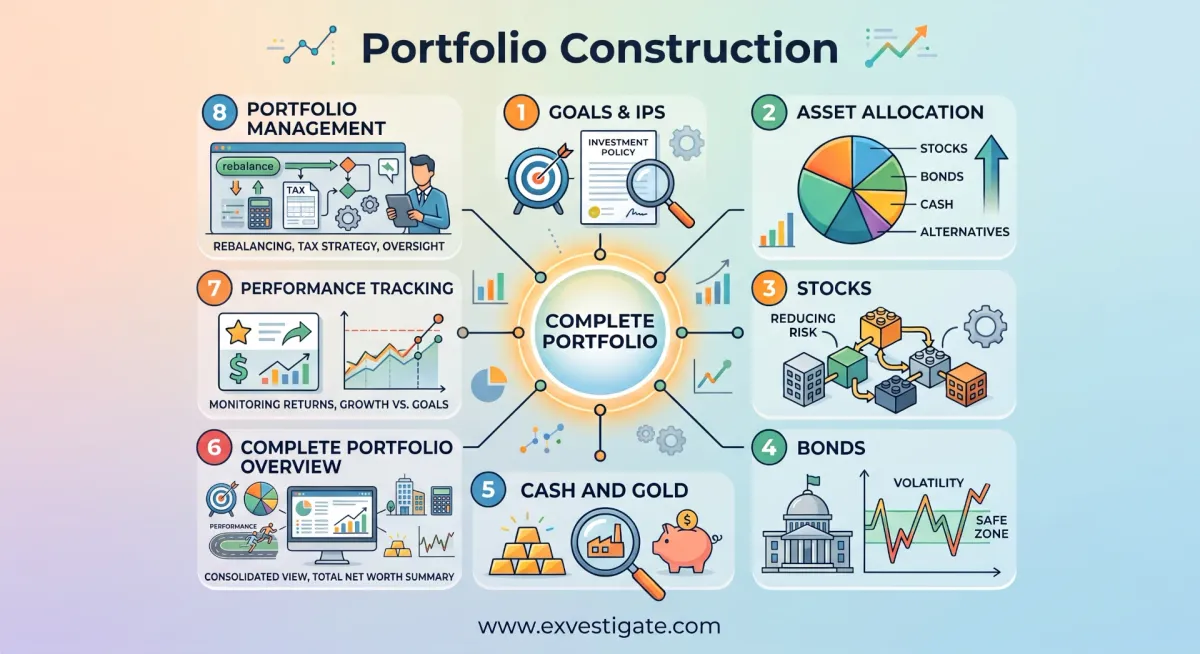
Part 1: Portfolio setup
The starting point. Sets the main objective - a 6% nominal return with a 4% income stream, dropping to 3% if returns come in at 5% or lower - and the target asset allocation (75% stocks, 10% bonds, up to 10% cash, 2.5% - 5% gold). Also introduces the three extra conditions that shape my portfolio for a great deal: a 40% EUR currency target, an underweight to the US, and an overweight to Asia and emerging markets.
Part 2: Product criteria
Before picking any actual products, the five criteria I screen ETFs against: fund size and liquidity, a low TER (and the less visible tracking difference), physical replication, leading asset managers tracking well-known indices, and how much data the provider publishes about the fund.
Part 3: Product choices - stocks
Applies those criteria to select the actual ETFs for the Market Stocks (30%) and Dividend & Value Stocks (45%) sleeves, balancing fund quality against the currency and regional targets from Part 1.
Part 4: Product choices - bonds
Why bonds still earn a place after 2022 broke the classic stocks-and-bonds diversification story, followed by the actual picks: a stable EUR corporate bond fund and two emerging market bond funds. Just so know, I see bonds as a necessary evil.
Part 5: Product choices - cash and gold
The simpler half of product selection: the cash-equivalent ETFs (a core EUR fund, plus a USD option and a €STR alternative), and the two physical gold ETCs. One of these currency-hedged, one not.
Part 6: The complete portfolio
Puts every selected product together into the full 14-fund blueprint, and checks the result against the objectives from Part 1: the realised EUR exposure (25.50%, short of the 40% target), the cost (about 0.20% TER), and whether the return and risk targets are actually met.
Part 7: Portfolio performance
Backtests the assembled portfolio using two different tools, looks at volatility and the Sharpe ratio, and checks the realised regional allocation against the Part 1 target. Along with an honest look at what backtesting can’t tell you.
Part 8: Portfolio management
The operating rules for actually running this portfolio through retirement: separating two types of cash, a three-tier drawdown waterfall for funding the income stream, and a twice-yearly rebalancing routine.
Start at Part 1 if this is your first time through the series, or jump straight to whichever part covers what you are interested in.